A project budgeted at €677,104.28, aiming to upgrade approximately 120 kilometers of hiking routes in the Municipality of Aktion–Vonitsa, has in recent months become the focus of a series of formal interventions by the Aktio–Vonitsa Hellenic Cultural and Athletic Mountaineering Association (EPAOS).
The prompt was not a political disagreement, but observations that arose when Association members tried to use and inspect routes presented as an organized hiking network.
The matter developed gradually: from seeking technical documents and undertaking initial field visits, to requests to the Municipal Authority, the Technical Service, the Aetolia-Acarnania Forest Directorate, and the Natural Environment and Climate Change Agency (NECCA).
1. The project and its initial commitments
The project “Creation of a National Network of Trails and Hiking Routes of the Municipality of Aktion–Vonitsa” was included in the broader program to create a national trail network, funded by the Recovery Fund.
The technical description, dated March 2025, provides for interventions to create safe, functional, user-friendly routes.
The physical scope includes, among other things, vegetation clearance, removal of obstacles, installation of directional and information signs, route marking, wooden structures, and accessibility improvements.
The tender notice was published on September 19, 2025, under KIMDIS number 25PROC017581168.
According to the file compiled by EPAOS, the contract was signed on December 2, 2025, with G.I. Karnomourakis S.A. as contractor.
In June 2026, media reports were presenting the network as organized and marked, with 16 routes totaling approximately 121 kilometers.
The prospect was particularly important for the area: developing hiking tourism, showcasing the Acarnanian Mountains, connecting natural and cultural attractions, and strengthening the local economy.
2. August–September 2026: EPAOS moves from promotion to inspection
In late August 2026, EPAOS announced its intention to organize hikes on routes in the municipal network.
The initial approach was positive. The Association sought to introduce residents and visitors to the trails, highlighting the area’s natural and cultural value.
However, as preparations for the outings began, the need arose for on-site checks of route passability, marking, and safety.
On September 1, 2026, the Association made a written submission to the Municipality, requesting information and technical details about the project; the need for field inspections was also raised.
A public call followed, inviting volunteers to help survey and record the condition of the trails.
EPAOS did not ask to replace the Technical Service or the contractor. It sought to contribute field information, drawing on its members’ experience in mountaineering, climbing, mountain safety, and technical sciences.
3. Initial findings in the field
During the Association’s reconnaissance visits, problems were recorded on specific sections of the network, according to EPAOS.
• Dense vegetation, brambles, and obstacles blocking passage.
• Incomplete or inconspicuous route marking.
• Discontinuities between routes mapped digitally and actual passability on the ground.
• Points where the route could not be followed safely.
• Questions about whether planned structures and information infrastructure existed or had been completed.
Routes 9, 10, 11, 12, and 13 in the Acarnanian Mountains were of particular interest.
On September 20, while reconnoitering the Vatos–Katarachia route, the Association’s group found that the digitally mapped route led toward a dangerous point near a steep slope, and consequently stopped the attempt to continue along the route.
These are the Association’s observations and need to be cross-checked against the approved study and the project’s technical measurements.
Their significance, however, is clear: publishing a route on a digital platform is not, by itself, enough to prove that it is passable and suitable for hikers.
4. Correspondence with the Municipality

During September, EPAOS continued its formal interventions, seeking information about the project’s technical and administrative details.
On September 26, a response from the Municipality was reviewed. It included references to administrative decisions, the Summary Table of Works, completion, and project procedures.
In the Association’s view, this correspondence did not resolve the substantive issue: cross-checking the declared works against the actual condition of the routes.
EPAOS insisted on the need for joint site inspections involving the competent services and scientifically qualified individuals.
At the same time, on September 29 it made public its intention to continue field recording, while keeping open the possibility of volunteer participation.
5. The additional 14,244.50 meters of clearance
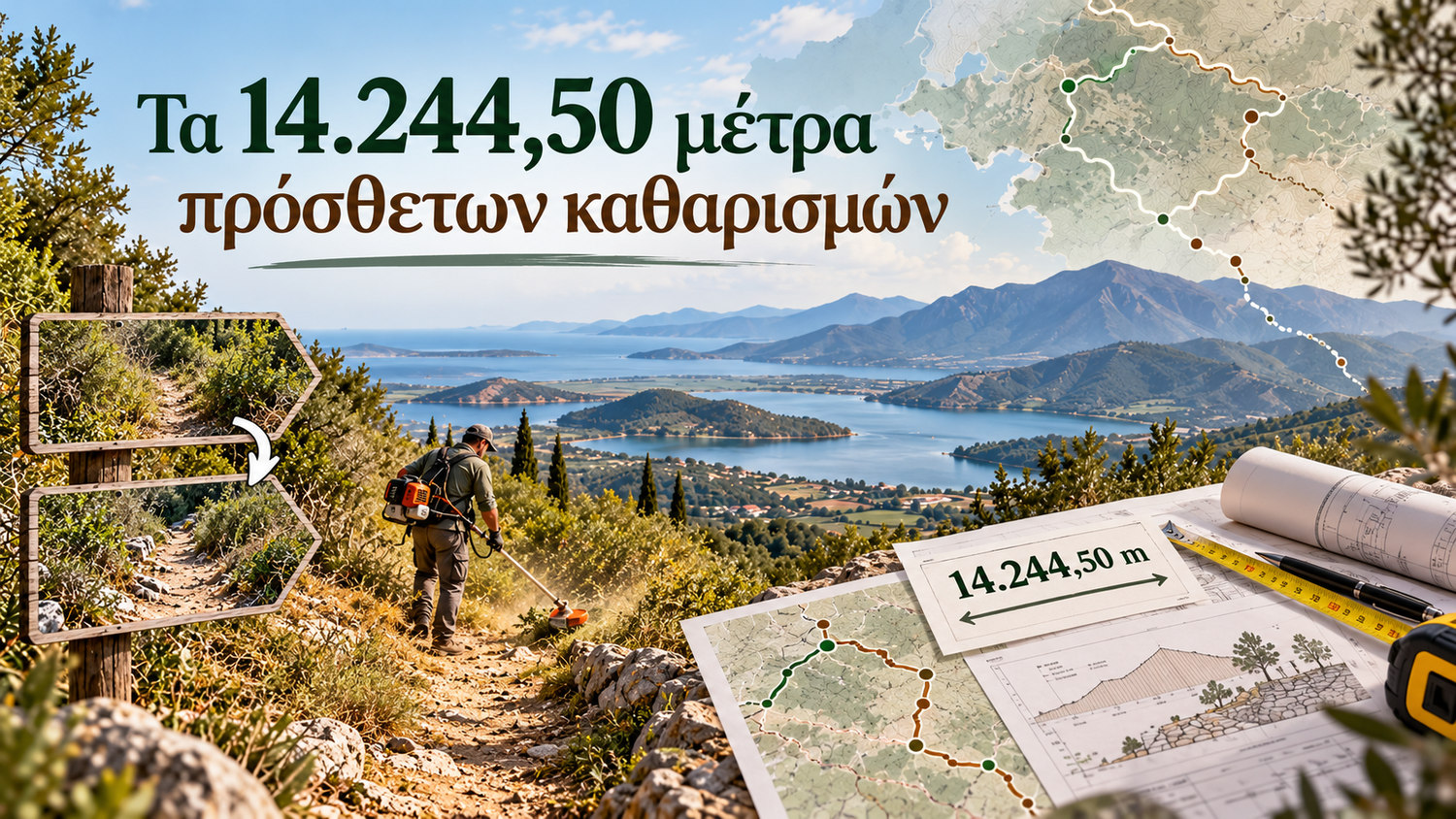
A particularly important detail appears in the transmittal from the Municipality’s Technical Service to the Aetolia-Acarnania Forest Directorate, dated July 7, 2026, concerning pre-approval of the first Summary Table of Works (STS).
The document refers to additional clearance totaling 14,244.50 meters, deemed necessary for visitors to pass safely and effectively.
The first STS was approved by Municipal Committee Decision 170/2026, according to the administrative records reviewed by the Association.
This raises specific questions:
• On exactly which routes and sections was the additional clearance carried out?
• What measurements and evidence certify the corresponding work?
• What was the condition of these sections when the physical scope was accepted or inspected?
EPAOS has not established that all the declared work was not carried out. It is asking, however, for an opportunity to compare the administrative records with specific locations on the ground.
6. October 2026: The matter takes on a broader institutional dimension
In early October, the Association returned with more specific proposals for joint site inspections.
On October 7–8, new requests were drawn up and forwarded both to the Municipality and to the Aetolia-Acarnania Forest Directorate and NECCA.
The focus was on technical documentation, measurements, inspection records, trail marking, passability, and safety.
The Association also proposed using a structured site-inspection form so that each observation would be recorded by route, with its location, photographic documentation, and a description of the problem.
On October 19, it followed up with a proposal for institutional cooperation and an invitation to submit observations on the hiking routes.
The approach remained focused on cooperation and technical verification of the facts on the ground, without prejudging the responsibility of any person or service.
7. An additional issue raised by a Forest Directorate document
The material reviewed also includes a report by the Forest Directorate dated July 20, 2026.
According to the summary of the report compiled by the Association, the tender documents were reviewed retrospectively, because the prior pre-approval stage had not been observed.
The same report concerns the review of administrative and tender-related records. By itself, it does not document an on-site inspection of the actual execution of the works.
The distinction is essential.
Reviewing the completeness of a tender notice or an administrative procedure is one thing; verifying that specific work was carried out at the planned locations and in accordance with the required specifications is another.
The above finding is not enough to characterize the award as illegal or the project’s execution as deficient. It is, however, a reason to clarify the administrative file further.
8. The latest communication and the outstanding joint site inspection
On October 26, there was encouraging informal communication from the Municipality, expressing support for the idea of forming a group to walk the routes progressively, possibly starting with the easier ones.
This position indicates that cooperation is possible.
However, as of October 29, 2026, based on the information available to EPAOS, no specific official schedule of joint site inspections—with set dates, participants, and inspection scope—has been announced.
The matter therefore remains open.
9. What is EPAOS ultimately asking for?
The Association’s position can be summed up in one basic principle: assessment of a hiking-trail project cannot be limited exclusively to its administrative completion. The actual functionality of the physical works must also be examined.
EPAOS requests access to the necessary technical information, geographic identification of the measured works, joint site inspections with the competent services, and recording of any discrepancies.
It also asks for clarification of who checked the routes’ passability, marking, and safe-use conditions, and what technical data they used.
It does not claim that a reconnaissance visit by volunteers can replace the competent technical or administrative inspection.
On the contrary, it seeks to have that inspection carried out formally and with the participation of the responsible parties.
10. What is really at stake for the area

Developing a reliable hiking network can bring significant benefits to Vonitsa, Palairos, the villages of the Acarnanian region, and the local economy as a whole.
To achieve this, however, more than digital maps and informational material are needed.
Routes must be genuinely usable, appropriately marked, accompanied by information about their difficulty, technically inspected, and supported by a maintenance plan.
The picture presented to visitors must correspond to the actual conditions on the ground.
The question that remains is not whether a project was approved or funded. It is whether the physical result meets the approved specifications and the needs of the people who are expected to use it.
EPAOS declares itself available for institutional cooperation, documented observations, and joint on-site examination of the routes.
The Municipal Authority and the competent services, of course, have the opportunity to present their own technical information, measurements, and inspection results.
Making this information public and jointly establishing the conditions on the ground can help clarify the matter.
Because completion of a project is not merely a date in an administrative document. It is also the result a citizen encounters when they reach the trailhead and try to walk the trail.
Hellenic Cultural & Athletic Mountaineering Association of Aktion–Vonitsa (EPAOS)
Related links
1. Project tender notice (PDF, Greek)